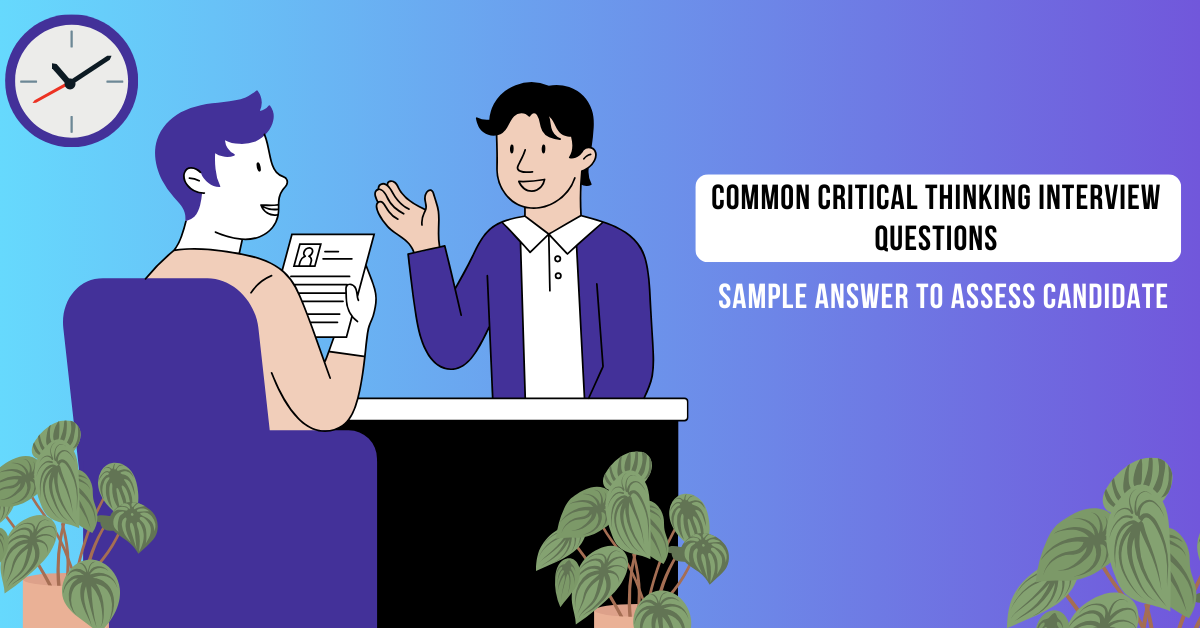


Critical thinking interview questions are among the most reliable tools for evaluating how candidates analyze information, solve problems, and make decisions under pressure. In a fast-moving workplace, employers cannot rely on technical expertise alone. They must assess reasoning ability, structured thinking, and judgment. That is why well-designed critical thinking questions for interview settings play a crucial role in identifying top performers. When used effectively, critical thinking questions and answers reveal not just what a candidate did—but how and why they did it.
Hiring managers increasingly recognize that structured evaluation of thought processes leads to better hiring outcomes. As workforce demands evolve alongside emerging technology and shifting business models, analytical reasoning has become a core competency across industries.
Organizations today face uncertainty, data overload, and constant change. Employees must interpret complex information, evaluate competing priorities, and make decisions with incomplete data. This is where critical thinking interview questions help differentiate candidates who react impulsively from those who think systematically.
When employers incorporate structured critical thinking questions for interview processes, they reduce hiring bias and improve long-term performance outcomes.
Simply asking critical thinking questions and answers is not enough. The evaluation framework matters just as much as the questions themselves, and ensuring candidates are equipped to meet these standards—by following resources like these 10 interview preparation tips—is key to a successful hiring outcome.
Look for:
For leadership roles, you may also integrate elements from our guide on leadership and decision frameworks within managerial hiring discussions, especially when combining analytical reasoning with strategic direction.
This comprehensive list is designed to improve hiring accuracy by incorporating critical thinking interview questions and critical thinking questions for interview, complete with detailed evaluation guidance.
| Question | Core Skill Tested | Key Indicators in Answer |
|---|---|---|
| Describe a tough decision with limited data. | Judgment under uncertainty | Risk evaluation, assumptions clarified |
| Identify a problem others missed. | Proactive analysis | Early detection, measurable outcome |
| How do you prioritize deadlines? | Structured evaluation | Clear criteria and trade-offs |
| Describe improving a flawed process. | Analytical improvement | Root cause, measurable result |
| Challenge a common opinion. | Independent reasoning | Evidence-backed argument |
A strong response should demonstrate a structured approach to decision-making, clearly outlining how options were compared, what risks were identified, and how the final choice was justified despite limited visibility.
Recruiter Insight:
“When candidates explain how they eliminated weaker options before choosing a path, it signals strong analytical maturity,” says Rayne W, Senior Talent Consultant at W3Global.
A strong response should explain the early indicators noticed, why others may have missed them, and how timely intervention created measurable impact.
Strong critical thinking questions for interview scenarios here reveal time allocation frameworks such as urgency vs. impact models. This aligns well with structured task management principles often discussed in remote and hybrid performance evaluation strategies.
The best critical thinking interview questions assess respectful disagreement backed by data or reasoning, along with the outcome or lessons learned.
A strong response should show how the idea was both original and realistic, detailing implementation steps and measurable results.
Effective critical thinking questions and answers should demonstrate active listening, thoughtful evaluation of feedback, and a professional, solution-oriented response.
A strong response should explain the reasoning behind the decision, how stakeholders were managed, and the eventual impact.
A strong response should demonstrate structured discussion methods, encouragement of diverse viewpoints, and reliance on data to guide conclusions.
A strong response should outline a step-by-step evaluation process, demonstrating logical progression from problem identification to resolution.
A strong critical thinking questions for interview response should demonstrate cross-verification, evaluation of source credibility, and alignment of data with decision context.
A strong response should acknowledge ownership, explain what went wrong, and demonstrate corrective action leading to improved results.
A strong response should describe pilot testing, scenario planning, or controlled trials used to validate ideas before full execution.
A strong response should explain how ambiguity was managed, what additional information was sought, and how cautious conclusions were drawn.
A strong response should demonstrate clarifying objectives, identifying constraints, gathering relevant information, and iteratively refining solutions.
Recruiter Insight:
“When a candidate explains how they would structure an unfamiliar problem—by clarifying objectives, identifying constraints, gathering relevant data, and testing assumptions—it shows they rely on a repeatable thinking framework rather than guesswork. That consistency is what separates reactive employees from strategic thinkers.”
— Dave M, Talent Consultant, W3Global
A strong response should explain how the underlying bottleneck was identified, what structural changes were made, and how improvements were measured.
A strong response should demonstrate evaluation of impact, stakeholder expectations, and consequences before determining the appropriate balance.
A strong response should show honest reflection, clear lessons learned, and evidence of behavioral change afterward.
A strong response should explain scenario analysis, stakeholder impact assessment, and long-term risk evaluation before action.
A strong response should demonstrate re-evaluation of assumptions, validation of conflicting data, and openness to revising conclusions.
Strong critical thinking interview questions responses should outline stakeholder consultation, risk mapping, contingency planning, and documentation of rationale.
Many employers stop at surface-level responses. To truly assess reasoning, follow up with:
Layered questioning strengthens the reliability of critical thinking questions and answers analysis, much like the strategies found in these 10 unique interview questions to ask candidates for better insights.
Critical thinking rarely operates in isolation. It overlaps with leadership evaluation, structured task management, and forward-looking workforce planning. For example:
Understanding emerging workforce shifts—particularly those shaping recruitment strategy in 2025—can further refine how organizations assess reasoning and adaptability.
If you want to deepen candidate insights beyond reasoning patterns alone, incorporating unique behavioral and scenario-based prompts can enhance predictive accuracy.
For candidates preparing to face critical thinking questions for interview, structured preparation techniques significantly improve clarity and confidence.
In today’s competitive environment, hiring for analytical reasoning is no longer optional. Well-crafted critical thinking interview questions help employers uncover structured thinkers who approach challenges logically and strategically. By integrating layered critical thinking questions for interview processes and carefully evaluating critical thinking questions and answers, organizations can significantly improve hiring accuracy.
Strong thinkers drive innovation, reduce risk, and improve team performance. Identifying them requires intentional questioning and structured evaluation.
At W3Global, we specialize in identifying professionals who excel in analytical reasoning, structured problem-solving, and strategic decision-making. If you want to enhance your hiring process and secure forward-thinking talent equipped for today’s complexity, connect with our recruitment experts today and build a workforce ready for sustained growth.